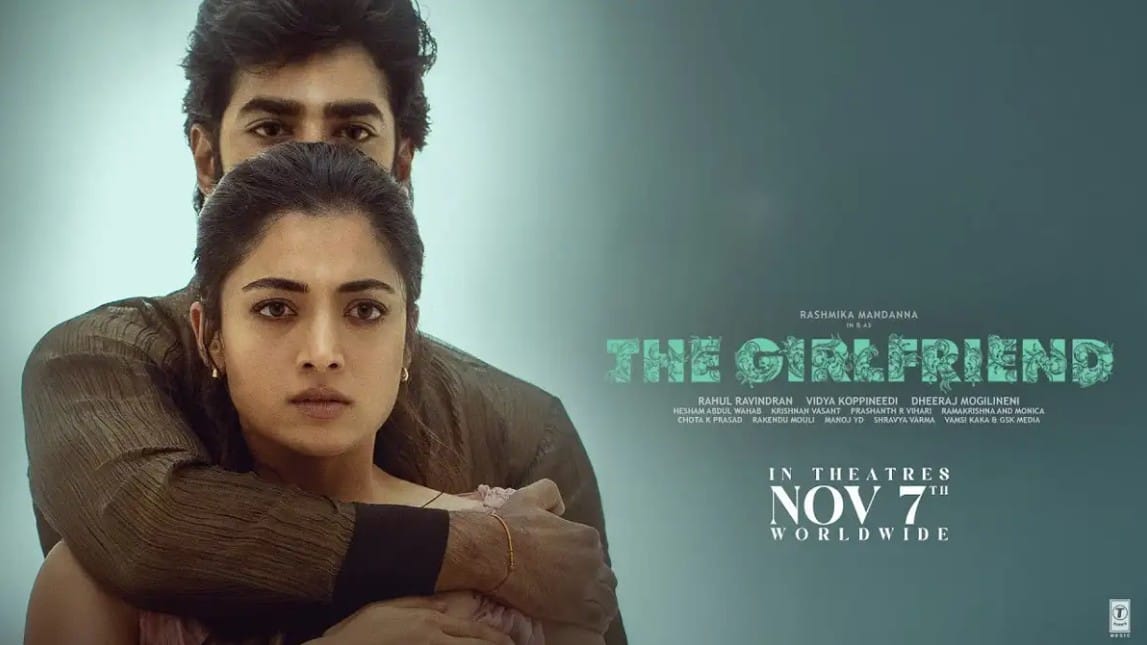
Telugu/2h18m/2025
Synopsis: Bhooma moves to Hyderabad to pursue her master’s in English literature, full of dreams. Soon, her life gets complicated when she develops a romantic interest in Vikram, who isn’t just charming but also self-centered and extremely possessive. His love bombs only seem to suffocate her. Can Bhooma really listen to her heart and stand up for herself?
Review:
While Sandeep Vanga’s Arjun Reddy received significant backlash, we should also not forget that many celebrated it. The audience sharply split into two groups—one found the film’s masculine glorification and its link to toxicity problematic, and the other simply enjoyed it, knowingly or unknowingly. But this will not be the case with Rahul Ravindran’s recent film The Girlfriend, as it dissolves this split between the two groups, allowing them to think from a female perspective.
What’s very interesting here is that there are many similarities between the protagonists of these two films, yet they feel very different. The Girlfriend seems like an antithesis of Arjun Reddy.
The male protagonists, Arjun (Vijay Deverakonda) and Vikram (Dheekshith), from these two films share similar traits—they are the real meaning of ‘macho man’. Their constant effort to make everything revolve around them and their failure to put themselves in other people’s shoes stand out as their top traits. The only difference here is that you relish Arjun while you find Vikram really annoying.
Similarly, Preethi (Shalini Pande) and Bhooma (Rashmika) seem ‘naive’, lacking clarity on what’s happening around them. They aren’t outspoken, and their lives often revolve around their boyfriends—they behave in a way that is completely opposite to being reckless. And, the difference? You hardly think about Preethi’s perspective in Arjun Reddy while you deeply resonate with Bhooma from The Girlfriend.
For instance, when Vikram kisses Bhooma for the first time, it feels very odd, as we easily understand that Bhooma isn’t ready—the subsequent events make it very clear. This wasn’t the case in Sandeep Vanga’s world.
As we watch the film, we’ll also see Vikram’s hypocrisy and how his arrogance affects everybody around him. Vikram does exactly the same thing he tells his girlfriend not to do—he tells Bhooma to end her friendship with a guy, claiming it’s for her safety and that he is doing it out of love; he even abuses her friend recklessly.
But in stark contrast, he is still friends with Durga (Anu Emmanuel) despite knowing about her romantic interest in him—their close encounters don’t look good. Such portrayal lets us think about the flaws in the societal standards imposed on men and women, that men can do anything, while women aren’t allowed to do the same.
Now let’s talk about Durga. How many times have we seen female protagonists having supportive friends in mainstream cinema? Durga is someone who’s calm, outspoken, and a supportive friend who helps Bhooma find her purpose. She warns Bhooma about losing herself if she continues staying with Vikram—she gently guides her friend to find a new path. While looking at this character, we all would wish to have a person like Durga in our lives.
Right from the beginning, Bhooma isn’t sure about her relationship with Vikram—peer pressure, the way she was brought up, and conditioned to ‘serve’ men in her life influence her decisions in split seconds. We’ll also see how she struggles psychologically to break free from cultural norms (that women shouldn’t be assertive) and stand up for herself—Rahul Ravindran captures them with an engaging screenplay.
We understand her inner battles better when she meets Vikram’s mother, who looks like an older version of Bhooma—in fact, it feels as though Vikram’s mother represents our own moms, who have sacrificed their lives for the men in their families without getting anything in return. Because of this, we truly empathise with Bhooma when she’s frightened by the idea of ending up like them. Along with an engaging screenplay, writing, and cinematography, the actors’ decent performances help us bond with the film.
The Final Verdict?
At the end, The Girlfriend by Rahul Ravindran looks like a wake-up call to people stuck in toxic relationships—it subtly asks them to rethink their choices and find a way out. The most compelling part of this film is that it shows what is supposed to be love isn’t actually love at all—love never asks you to sacrifice your needs, or your existence. The Girlfriend also shows how manipulation and control happen in subtle ways—at least by now, let the director of Arjun Reddy realise that people ‘slapping’ each other isn’t romance, and abuse often happens without any noise.