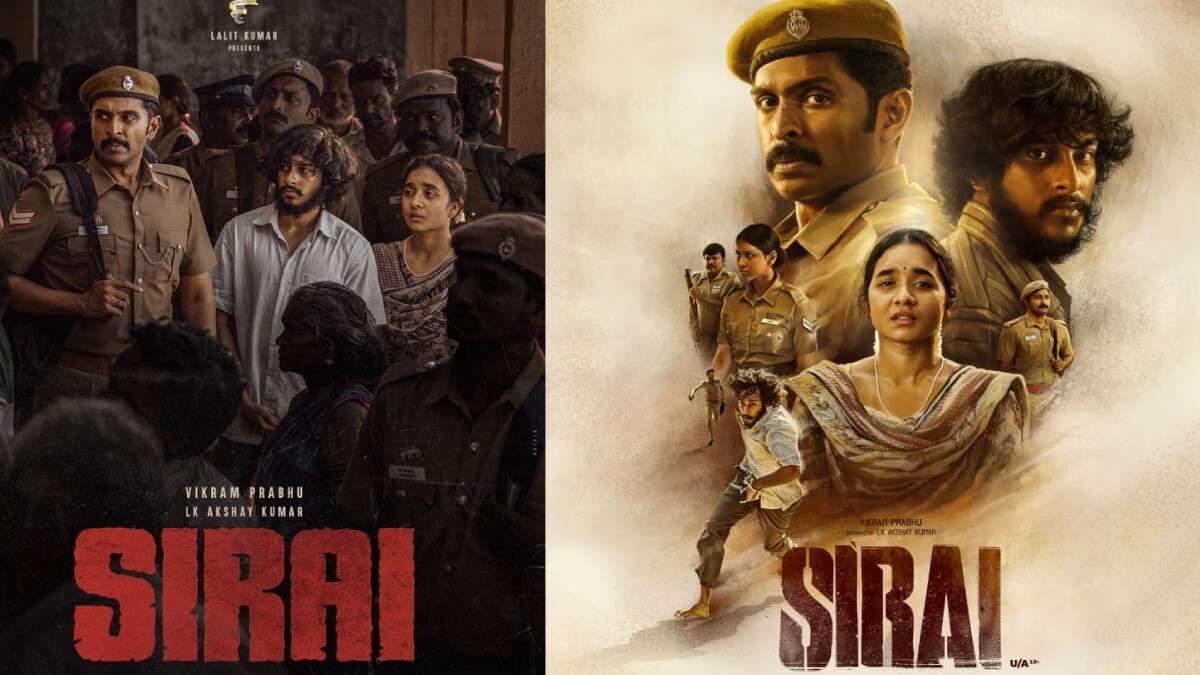
Tamil/2h5m/2025
Synopsis: As soon as Kathiravan finds that the senior officer is reluctant to let his colleague see his ailing mother due to an upcoming escort duty, Kathiravan willingly steps up to replace him. He is assigned to move a murder accused Abdul from Vellore to Sivagangai prison. His journey with Abdul sees twists and turns as empathy coexists with prejudice and institutional bias.
Review:
2025 has been a great year for the Tamil industry as it has witnessed plenty of great films. The fact that the year has ended with Suresh Rajkumari’s Sirai makes it more special. Sirai is a compelling police drama which showcases how prejudice and institutional failures affect the lives of minorities. In other words, the film exactly feels like it came straight out of Vetrimaran’s universe.
This isn’t just because of the director, who comes from Vetri’s school, but also because of the writer Tamizh, a former cop and director of ‘Taanakkaran’. Since he comes from a police background, he is able to address nuanced issues within the system through his writing, making Sirai more realistic.
(Sirai’s depiction of the police system)
The film wastes no time in preparing us for what comes next with a compelling opening scene. We understand that the story is going to revolve around lower-ranking police officers and their escort duties. We see how their lives are often at stake and how the system overlooks this fact; we see how hierarchies in the police system affect lower-ranking officers, frequently expecting them to perform beyond human abilities.
The film also shows the police procedures that follow when an escort officer fails in his duty, often leaving one burnt out. With this initial establishment, we grasp the characters’ inner agony, especially head constable Kathiravan (Vikram Prabu), and start travelling along with him until we are introduced to the character Abdul (Akshay).
Things get really interesting when Kathiravan takes the responsibility of moving a murder accused, Abdul, from Vellore to Sivagangai prison. There’s always tension throughout this part as Abdul looks as if he is going to escape—whether it’s the initial tea shop scene, Kathiravan locking him inside the bus, or his colleagues’ careless drinking, we find ourselves wishing that nothing would happen.
(Life of Abdul)
But, soon our wishes change when we get to know more about Abdul. We are truly moved, just like Kathiravan, when the story delves into Abdul’s past. As he belongs to the muslim community, his life has been marked by difficulties since childhood. His parents had to run an extra mile to settle down in a populated area. Even though his neighbours seem jovial, at times he’s reminded that he isn’t one of them—his romantic relationship with Kalaiyarasi (Anishma), who is from a different religious background, is an example of that.
It wouldn’t be wrong to say that the tension sparked by his romantic interest changes Abdul’s life upside down. In addition to this, his life becomes a living hell due to systemic failures—things like not being able to provide the working class population with a support system, prejudice and neglect due to religious identity, and delayed justice crush Abdul’s soul.
(Who is Kalaiyarasi)
Another important aspect of the film is the characterisation of Kalaiyarasi. We have been seeing some good female characters of late in Tamil films, and Kalai might also join that list. She is bold, adamant, thinks independently and makes conscious choices. Moreover, she breaks the family’s honour—unfairly placed on her—by choosing to stand with Abdul. The events that happen around this character expose the double standards of Indian families.
Like, in a particular scene, Kalai’s sister asserts, ‘Nobody has a problem with losing our family’s honour when my drunken husband abuses me every day, but as soon as Kalai falls in love, you lose your mind’. Such moments add more depth to the film. Also, the film is nothing without the artists’ tremendous performances. Along with them, soulful music, engaging screenplay and camera work collectively operate to keep us engaged until the very end.
The Final Verdict?
Sirai proves that films can also engage you without ‘masala’ elements. Tamizh’s nuanced writing and Suresh’s tight direction make things work. Sirai also reveals another side of the state apparatus, making it a thought-provoking watch. Also, Abdul and Kalai are characters who will stay with you long after the film ends.